Search This Blog
Showing posts with label hereditary. Show all posts
Tuesday, June 26, 2012
Willebrand Disease
Von Willebrand disease, or vWD, is an inherited disorder that affects the blood's ability to clot properly. As a group, bleeding disorders (including hemophilia) are rare. Von Willebrand disease affects as much as 1% of the population or more.
A substance in the blood known as von Willebrand factor helps platelets stick to damaged blood vessels. Another function of von Willebrand factor is to carry the important clotting protein, called factor VIII, in the blood. People with vWD have a problem with one or both of these blood components.
In many people with von Willebrand disease (vWD), the signs are mild or they may be absent altogether. When signs occur, their intensity can vary from one person to another. Von Willebrand disease is often challenging to diagnose in milder cases.
Symptoms
Abnormal bleeding is the most common sign of von Willebrand disease, although it may be present at only moderate levels.
The abnormal bleeding associated with von Willebrand disease may occur as:
* Recurrent and prolonged nosebleeds
* Bleeding from the gums
* Increased menstrual flow
* Excessive bleeding from a cut or following a tooth extraction or other dental procedure
* Blood in the stool or urine
* Bleeding from shaving with a razor
* Easy bruising
* Bruises with lumps that form underneath the skin
Some people may realize that they have a bleeding disorder only after a surgical procedure or serious trauma in which excessive bleeding occurs.
Diagnosis
Ideally, a simple, single laboratory test could screen for the presence of VWD. Such a screening test would need to be sensitive to the presence of most types of VWD and would have a low false—positive rate. Unfortunately, no such test is available. In the past, the activated partial thromboplastin time (PTT) and bleeding time (BT) were recommended as diagnostic tests.
Treatment
Mild bleeds may be treated with pressure and are often self-limiting.
Hormones found in oral contraceptives administered intravenously, orally, topically, or by patch application.
Localized bleeding in the nose or mouth may be treated at the site with Thrombinar, Avitene, or Instat followed by a medication such as Amicar.
source: sangga or click here
Marfan Syndrome
Marfan syndrome is an inherited disorder of connective tissue, although about one-quarter of all cases occur without any family history of the syndrome. Marfan syndrome is caused by a defect in the fibrillin 1 gene on chromosome 15. It affects both men and women of all ethnic backgrounds. About 1 in 5,000 people have Marfan syndrome.
Symptoms
Marfan syndrome affects many areas of the body. Symptoms may include:
* tall and thin body type
* long arms, legs, fingers, and toes
* flexible joints
* curvature of the spine (scoliosis)
* chest sinks in (pectus excavatum) or sticks out (pectus carinatum)
* weak and fragile aorta, the main artery that carries blood away from the heart - it may become enlarged (aortic dilation) or develop a bulge (aneurysm), or may tear and burst (aortic dissection)
* severe nearsightedness, and sometimes dislocated lens of the eye
A person with Marfan syndrome has at least 3 symptoms in different parts of the body.
Diagnosis
If Marfan syndrome is suspected, a thorough physical examination should be done, as well as special testing. This would include:
* A complete family medical history and family tree
* Echocardiogram of the heart by a cardiologist
* Examination of the skeleton and measurement of body proportions
* Full eye examination by an eye doctor
Treatment
There is no cure for Marfan syndrome, but there are treatments that can help prevent or minimize its complications. The biggest threat to people with the syndrome is the sudden tearing of the aorta, a medical emergency which can be fatal. Therefore, close monitoring by a cardiologist and surgical repair of a weak aorta will save many lives. Blood pressure medications can also reduce stress on the aorta, as can avoiding strenuous exercise and contact sports.
In addition, regular physical examinations to monitor bones and joints and eye exams to watch for lens dislocation will help the person with Marfan syndrome. With good medical care most people can have a good quality of life and live a normal lifespan.
source: sangga or click here
Friday, May 6, 2011
Inherited Ataxia Disorders
Ataxia Telangiectasia
Affects central nervous system, eyes, skin, and immunity
Ataxia telangiectasia is a genetic disorder that affects the central nervous system, the eyes, skin, and immune system. Ataxia telangiectasia affects both males and females and has been estimated to occur 1 in 40,000-50,000 individuals.
Symptoms:
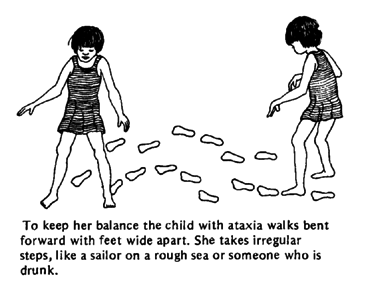
1. Central Nervous System: loss of muscle control, leading to swaying of the head and trunk on standing; by age 10 children often need a wheelchair.
2.Skin: tiny red lesions, like spider veins, appear at the corners of the eyes and spread.
3. Immune System: impaired immune system leaves child open to recurrent respiratory infections.
Other symptoms may include delayed growth, difficulty speaking or swallowing, and dry coarse hair (which may be partly gray) and skin. About 20% of children with ataxia telangiectasia develop cancer such as leukemia or Hodgkin's lymphoma.
Diagnosis
Diagnosis is based on the symptoms the child has, especially the poor muscle control and the tiny red lesions on the eyes and face. The gene for ataxia telangiectasia has been identified, so genetic testing can be done to verify the diagnosis. Children are usually diagnosed sometime in early childhood (between ages 2-1/2 to 7 years old).
Treatment
There is at present no cure for ataxia telangiectasia, or way to slow down the progress of the disease. Treatment is aimed at relieving symptoms and trying to prevent respiratory infections, which are often the cause of death. Unfortunately, the outlook isn't very good; children with the disorder generally do not live beyond their teens or early 20s.
source: rarediseases.about.com
Subscribe to:
Posts (Atom)